Vineyard management for the UK
Your whole vineyard, in one place.
Uvavu is an app for running a UK vineyard. Map your blocks, organise the team’s work, track growth and ripening, keep your spray records, and get told each morning when the weather has put your vines at risk of disease. On a computer, and on your phone in the rows, even without signal.
One account, at your desk and on mobile.
Sound familiar?
Jobs on a whiteboard, the spray diary in the van, refractometer readings on the back of an envelope and the forecast on someone’s phone. Then the buyer asks for the season’s records, and nobody’s sure who topped Chapel Field.
Uvavu keeps all of it in one place, so the whole team works from the same information.
Through the year
From pruning to picking
Each job, reading and record is filed against the block it belongs to.
Winter
Plan and prepare
- Pruning and tying-in jobs on the board
- Spring count of the chemical store
- Blocks, varieties and season dates set up
Spring
Watch it wake
- Budburst and growth stages, block by block
- Frost warnings for the nights that matter
- The first disease checks of the year
Summer
Keep it clean
- Leaf removal and topping, recorded as they’re done
- Scouting notes with photos
- Spray timing and the records behind it
Autumn
Bring it in
- Sugar and acid against last year’s
- Yield sampling and a forecast per block
- Harvest records and the season’s export
Blocks and maps
Every block, drawn once and known by everyone
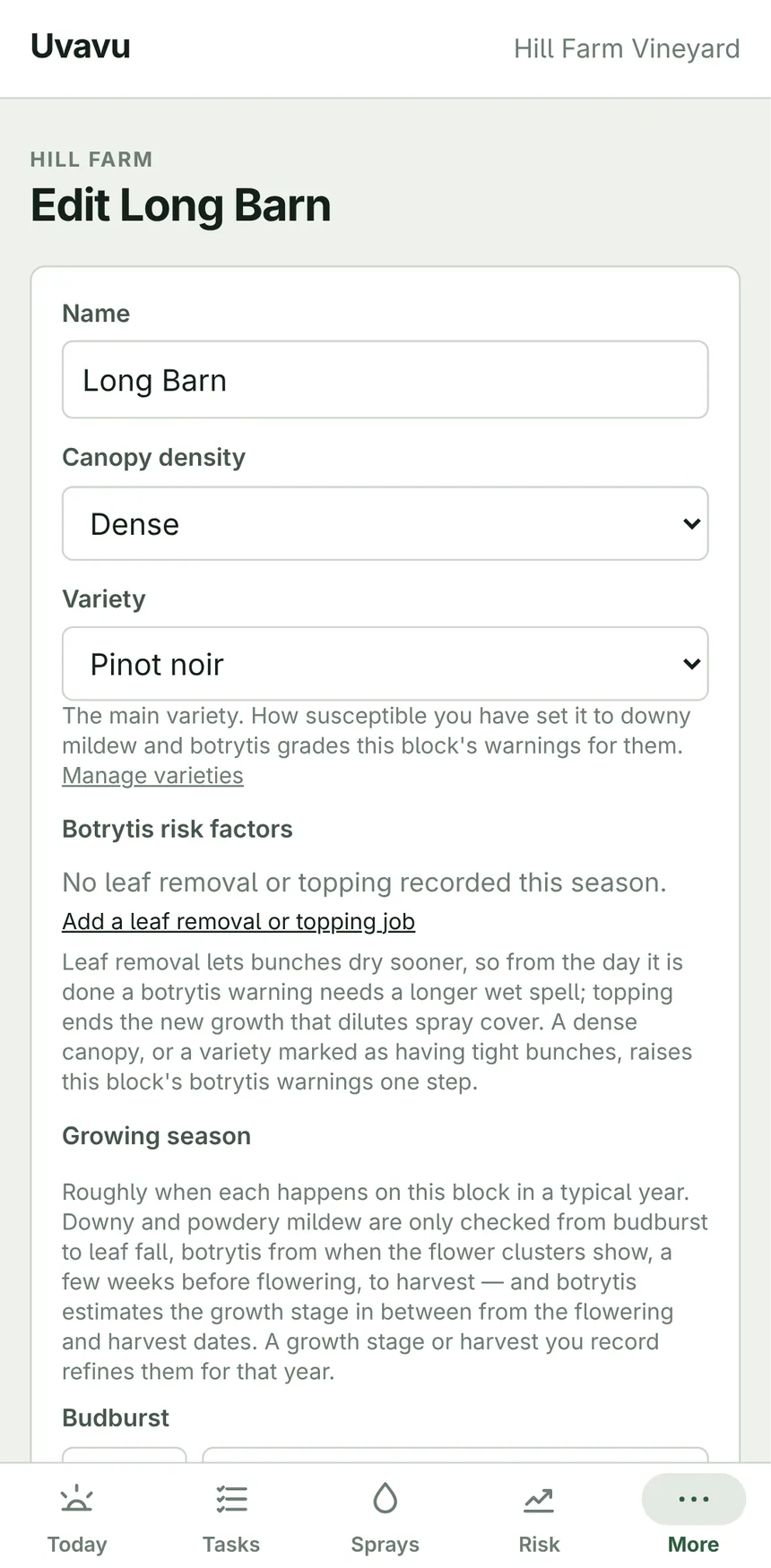
Draw each block’s outline on a satellite map and Uvavu works out its area. Add the variety and roughly when it reaches budburst, flowering, harvest and leaf fall. Every job, note, spray and warning is then filed against the right block, on one site or several.
The team
Everyone knows what’s next, even out of signal
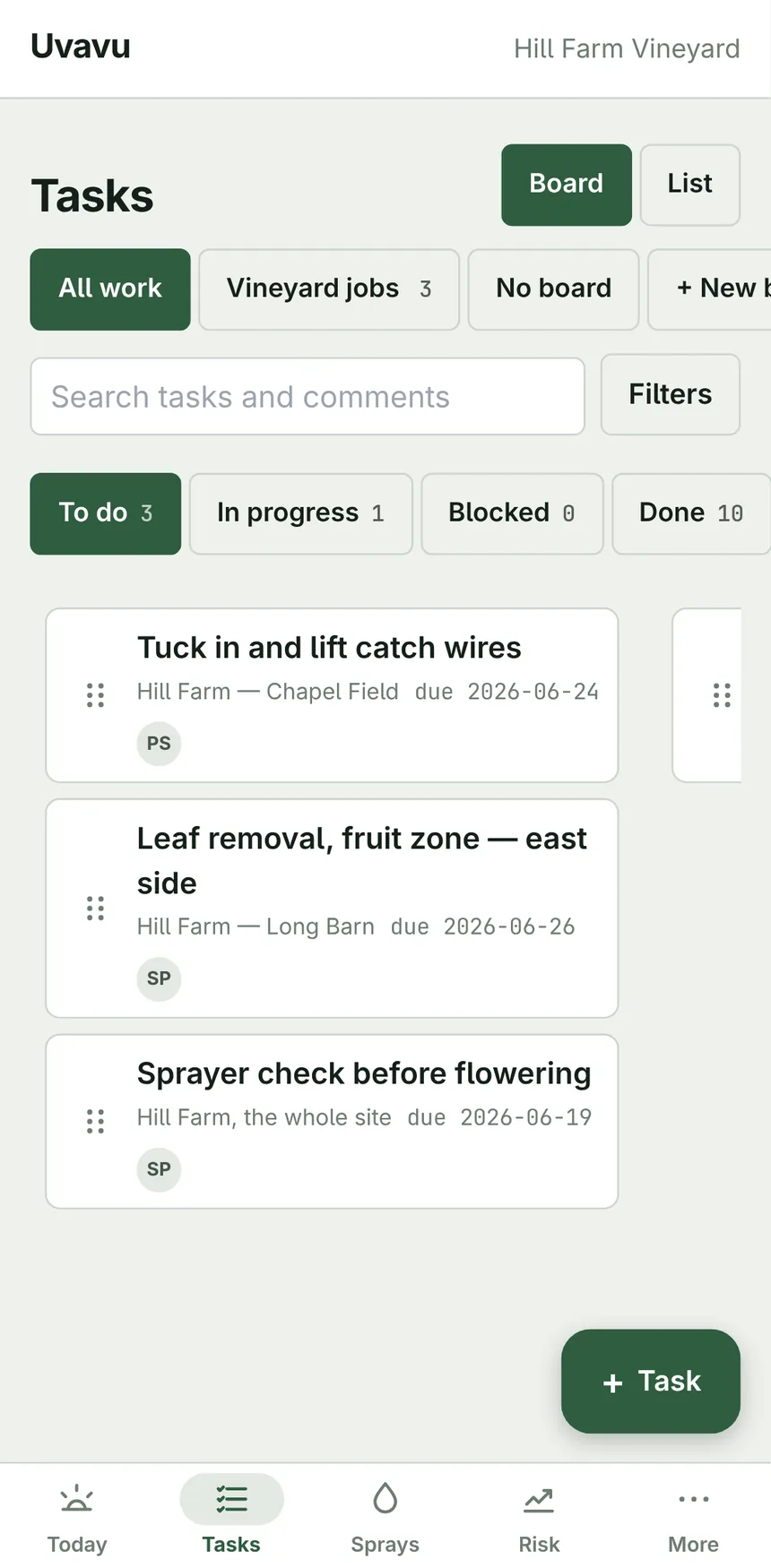
A shared job board for the whole crew. Assign a job, comment on it, add a photo, pin it to a block or an exact spot in the row, and drag it to Done when it’s finished. The phone app works with no signal and catches up when it’s back in range. Each person gets the access their role needs, and no more.
Field notes, ripening and harvest
Watch the season come in, block by block
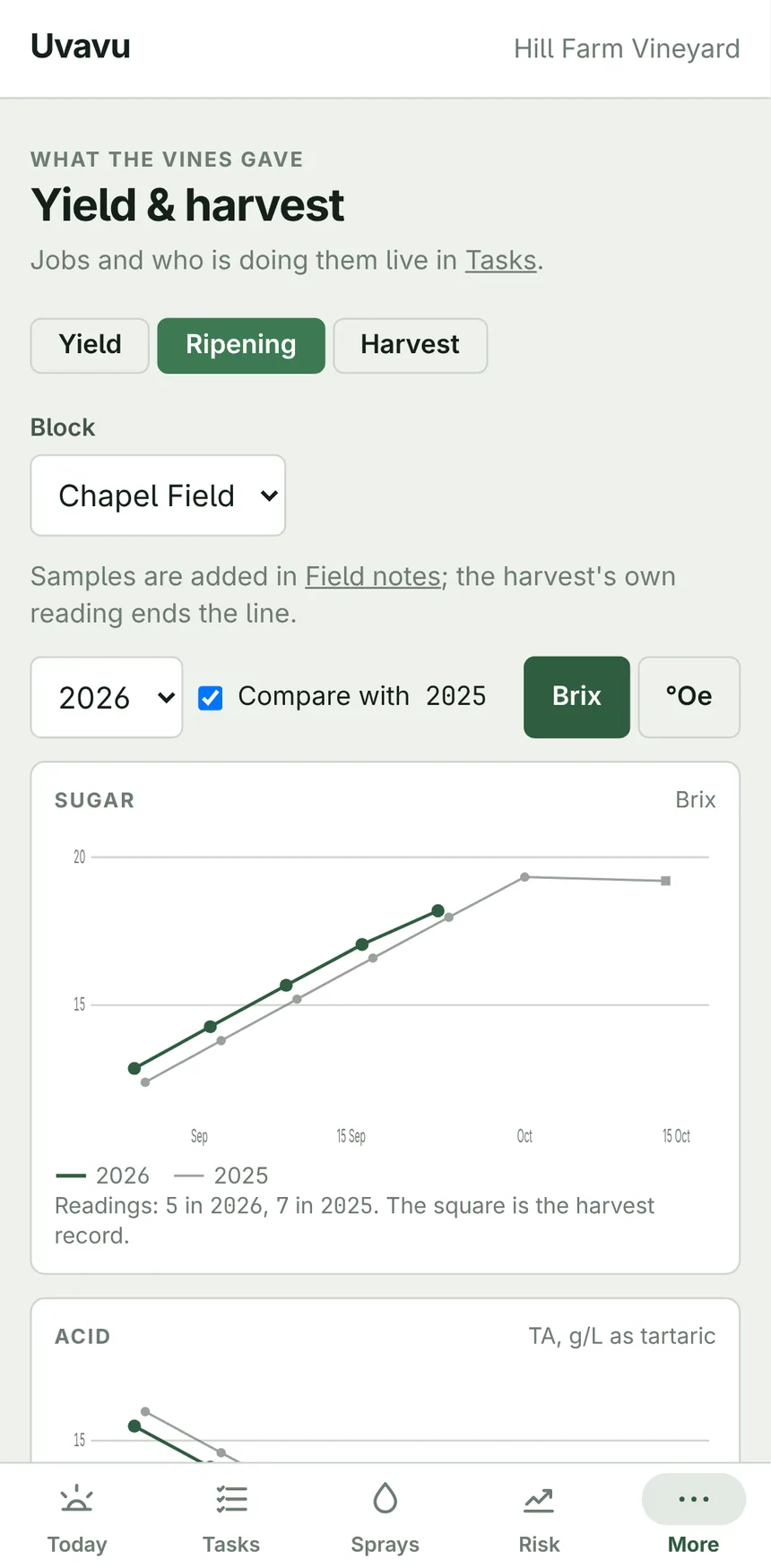
Record growth stages, disease sightings and sugar and acid readings as you walk the rows. Enter sugar in the scale your refractometer shows (Brix or Oechsle) and compare it with last year on the same dates. Count sample bunches for a yield forecast, then record what each block actually produced.
Protecting the crop
Know when to spray, and keep the records to prove it
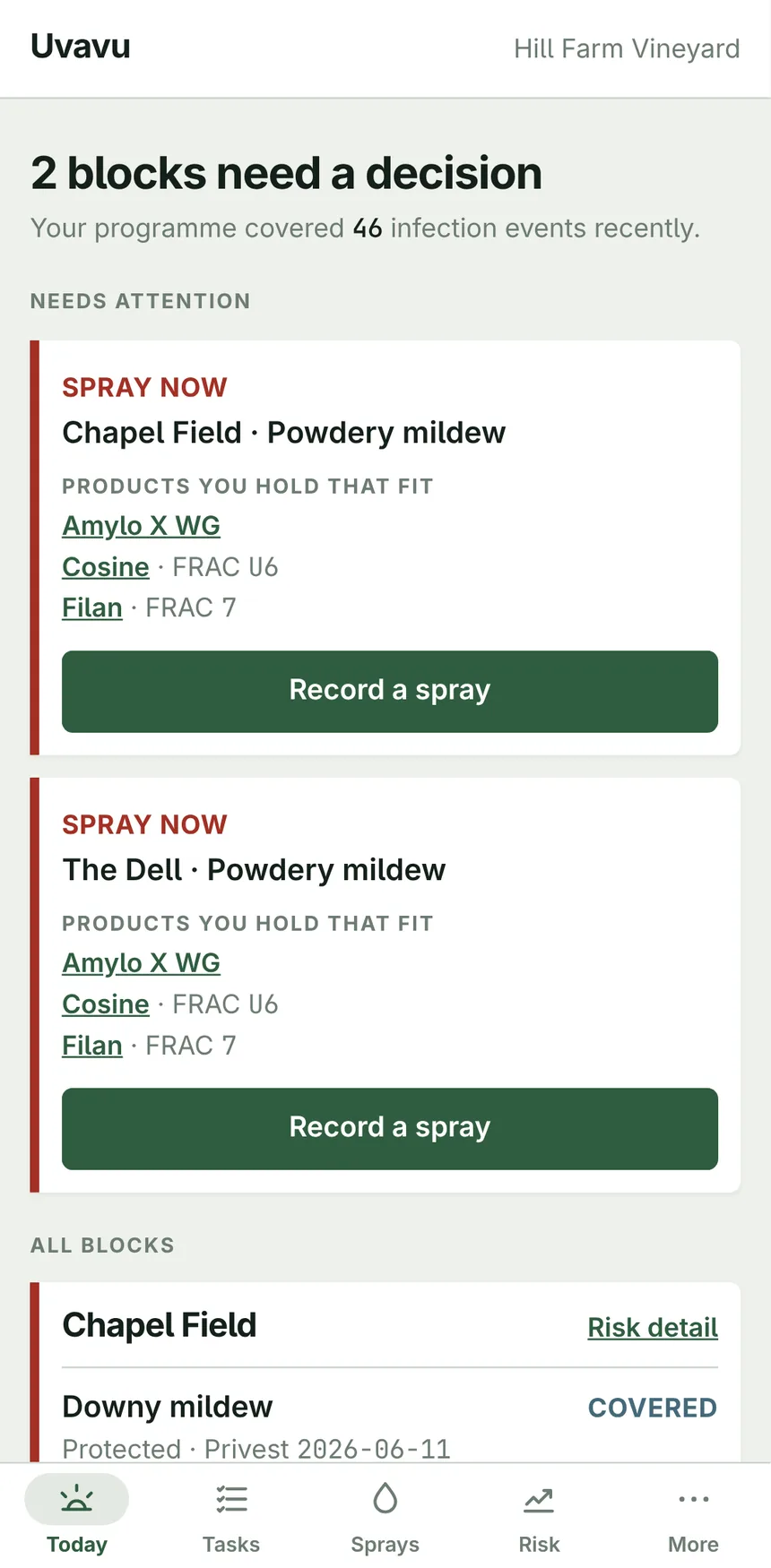
Every hour, Uvavu checks your weather for the conditions that lead to downy mildew, powdery mildew, botrytis and frost. Each morning it tells you, block by block, whether you need to act.
Disease risk
One decision per block, every morning
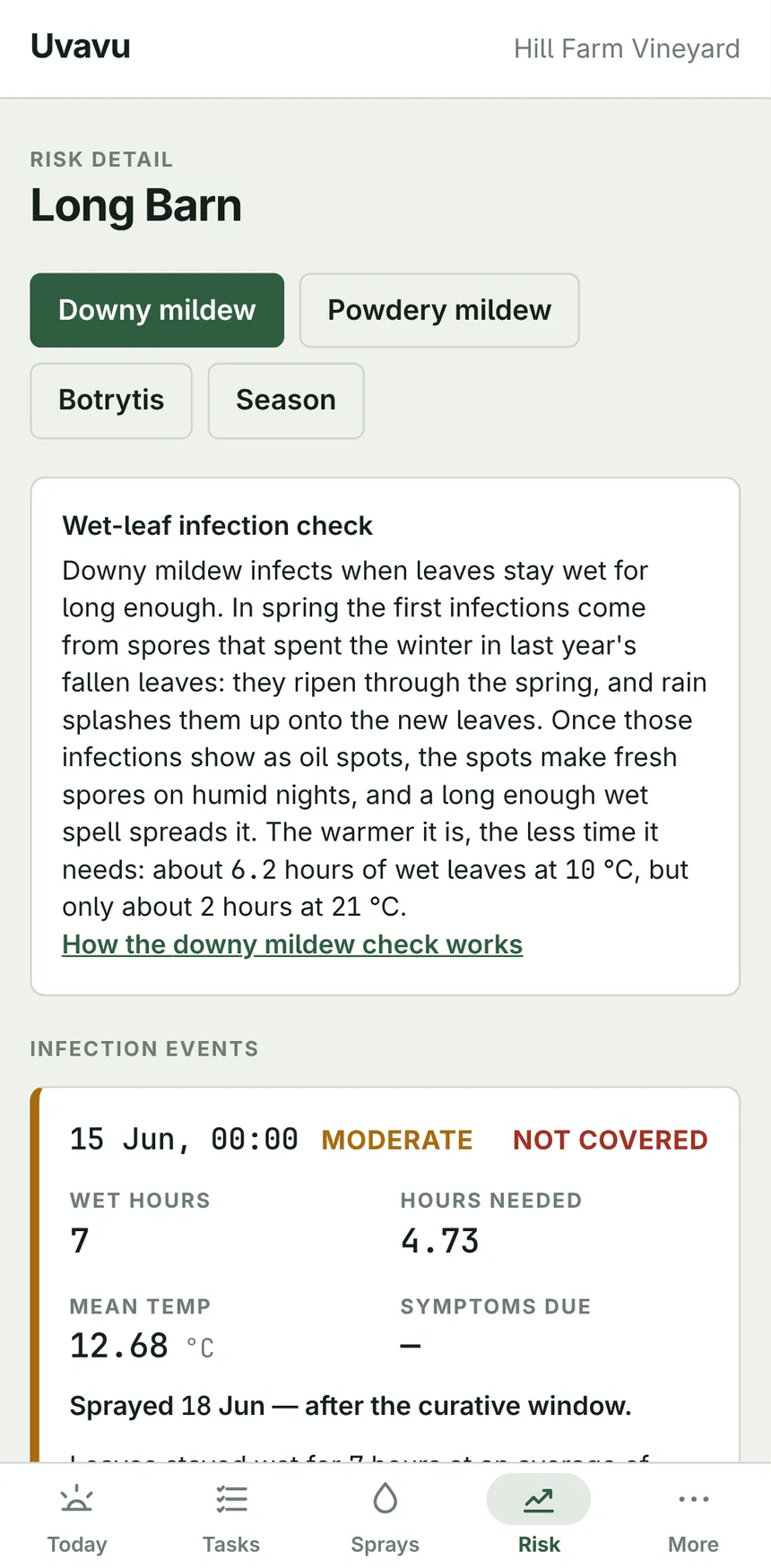
Each disease is checked with a model published by plant scientists, using your site’s hourly weather, and only during the part of the season when it can infect: mildew while the vines are in leaf, botrytis from about a month before flowering to harvest. For each block and disease you get one answer:
- Spray, and the deadline to do it by
- Watch: a light risk, so check the vines on a given date
- Covered: your last spray still protects the block
Every warning says why
The reasons, in plain English
Each answer comes with a short explanation: what the weather did (rain, how long the leaves stayed wet, how warm it was), how serious the risk is, and whether your last spray still protects the vines.
It also says how sure it is, as High, Medium or Low, and why. For example, leaf wetness was estimated because there is no sensor, or the warning rests on a forecast rather than measured weather. Each reason comes with what you can do to make the next answer more certain.
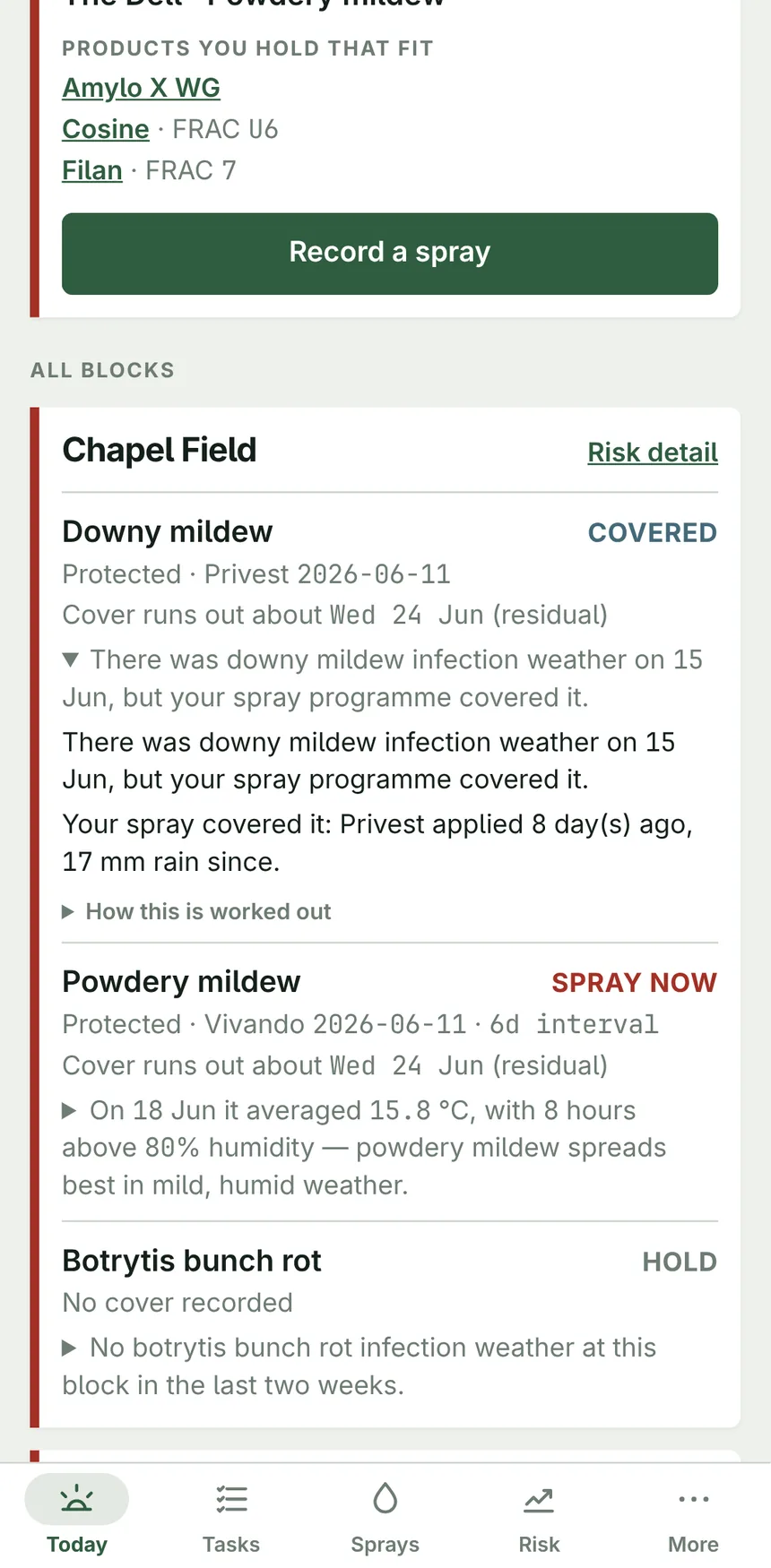
The app’s own words. Every figure in them is one the model used.
Spray records
Records ready for an inspector
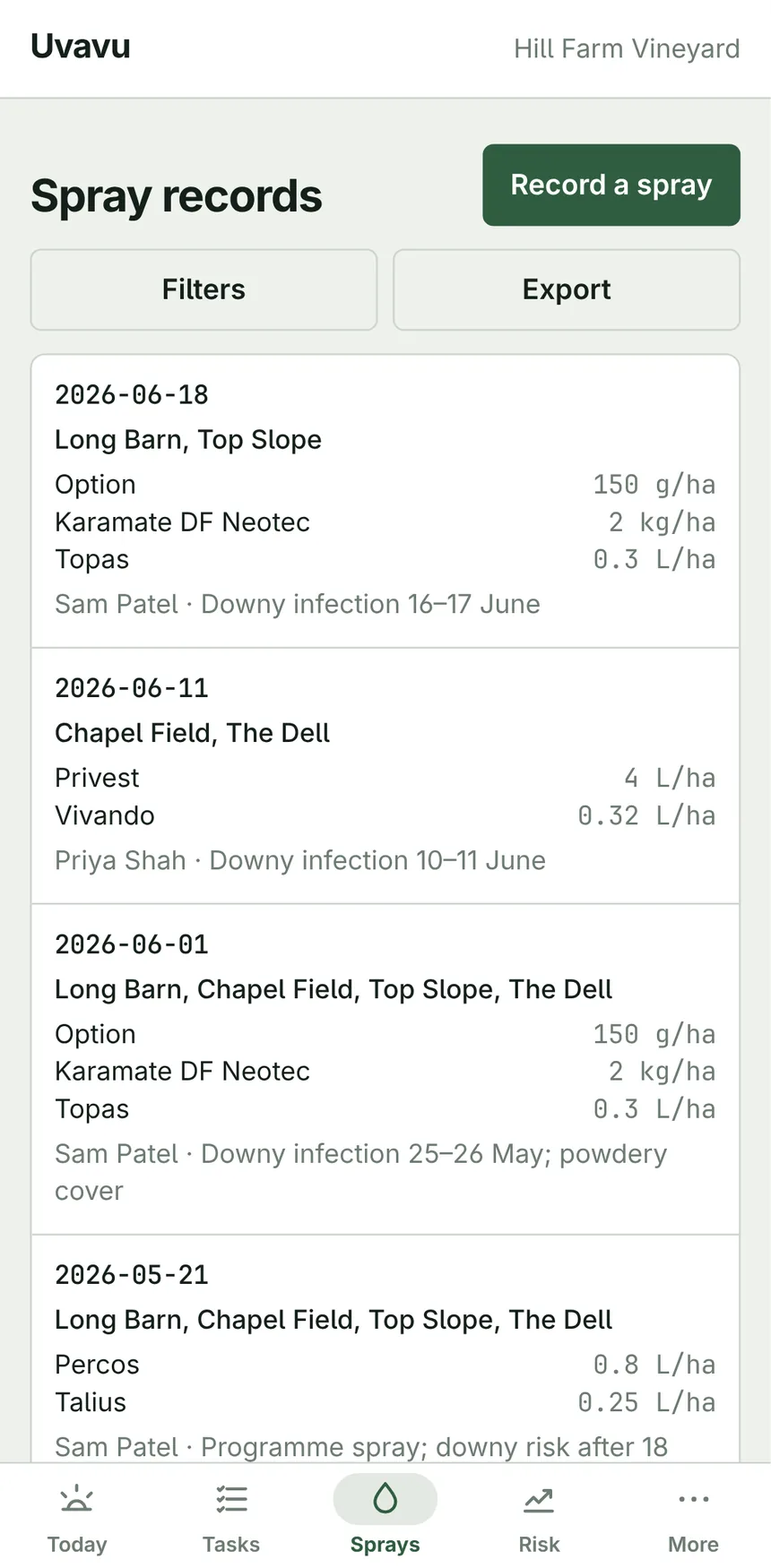
Record a spray in a minute, straight from the warning that prompted it. Uvavu checks the dose against the product label, only suggests products whose harvest interval fits before your harvest date, and keeps the original when a record is corrected. One click exports the season’s records for an inspector or a buyer.
Weather
Your own station, or a forecast for your field
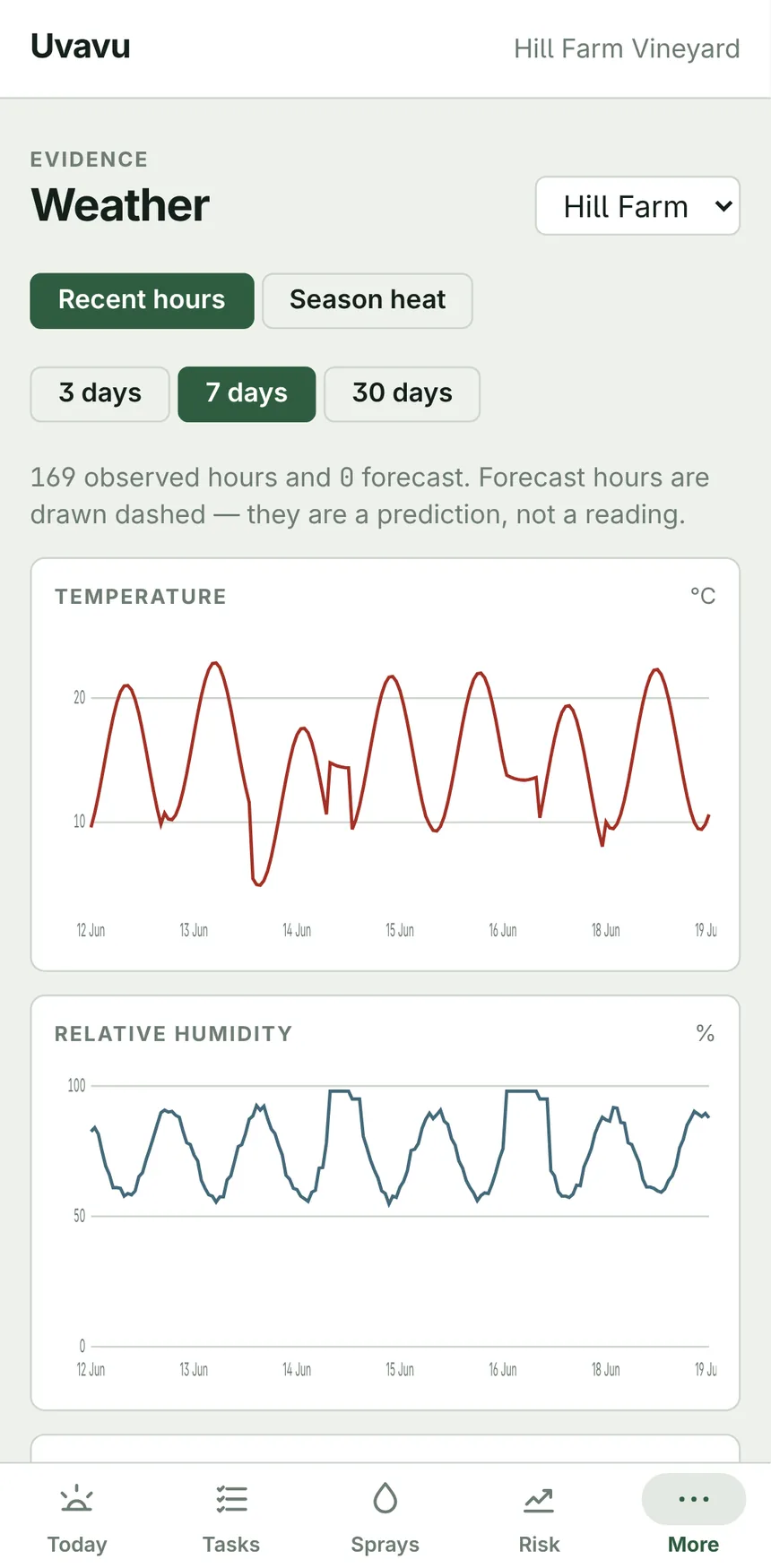
Connect your own weather station (Davis, METOS, Ecowitt or Weather Underground) and the disease checks use what actually fell on your vines. No station? Uvavu uses weather data for your location instead, and its warnings say so.
Also in Uvavu
The rest of the operation
The science
Built on published research. Honest about its limits.
The disease checks use models published by plant scientists, and the help pages quote the thresholds they use. Those models were developed in France, Italy, Germany and California, not the UK, and we say so.
What it's built on
- Downy mildew: Rossi et al. (2008); Caffi et al. (2016)
- Powdery mildew: Caffi et al. (2011); OiDiag, Kast & Bleyer (2011)
- Botrytis: Broome et al. (1995); González-Domínguez et al. (2015)
- Your recorded growth stages, sprays and scouting
What we won't tell you
- A percentage chance of infection. No UK data could back one
- How much to spray. Warnings name suitable products you hold, never a dose
- That missing weather data means no risk
- That a forecast is a measurement
How it works
Set up in an afternoon
Draw your blocks
Trace each block on a satellite map and set its variety and season dates. Defaults are there if you don't know them yet.
Connect your weather
Link your station, or let Uvavu use the forecast for your site. Last season's weather can be loaded too.
Bring the team in
Invite your crew and your adviser, each with the role they need, and put the season’s jobs on the board.
Put the whole season in one place
Draw your blocks this evening and invite the team. Tomorrow everyone works from the same picture.
One account, at your desk and on mobile.
Contact us
Ask us anything
A question about your vineyard, your weather station or getting your team set up. It comes straight to us, and we reply by email.